
Quick Answer: There is no set timeline for becoming an “alcoholic.” Doctors use the term alcohol use disorder (AUD), which can develop over weeks, months, or many years depending on how much, how often, and how early someone drinks, plus genetics, mental health, and environment. Heavy daily drinking can cause physical dependence within weeks to months. If you’re asking whether you have a problem, it’s worth taking seriously and talking to a professional.
Important: If you drink heavily every day, don’t stop suddenly without medical guidance. Alcohol withdrawal can cause seizures and can be life-threatening. Call 911 for a seizure, confusion, or hallucinations.
Prefer to listen? Play the audio version below:
Alcohol is one of the most commonly abused substances in the United States. Alcohol is legal for sale and use throughout most of the country, making it widely accessible to many people.
Alcohol abuse, including binge and heavy drinking, can lead to serious complications, including addiction. But how fast can alcohol addiction develop?
This article will explore alcohol addiction. You will learn:
- How alcohol abuse and addiction occur
- How long it takes to get addicted to alcohol
- How to recognize the stages of alcohol addiction
- Where to find alcohol addiction treatment
We’ll also look at real-world examples of alcoholism by looking at what Reddit users say about how long it takes alcoholism to develop.
If you or someone you love struggle with alcohol abuse or addiction, you are not alone. Find comprehensive treatment and recovery support programs at Moving Mountains Recovery. Contact our intake team to learn more about our programs or to schedule an intake assessment.
Understanding Alcohol Addiction
People drink alcohol for many reasons. They may drink to fit in with peers, to get the pleasurable effects of alcohol, or to dull physical or emotional pain. While moderate drinking may fit into a generally healthy lifestyle, some people regularly drink more alcohol than experts recommend.
Over time, excessive alcohol consumption can lead to serious health complications, including addiction. People who engage in heavy drinking may develop signs of addiction, including:
- Tolerance (needing to drink alcohol in greater amounts to feel the effects of alcohol)
- Experiencing cravings for alcohol
- Experiencing alcohol withdrawal symptoms if they stop drinking
- Continuing to drink even when facing severe consequences of their drinking
Over time, people may develop a physical alcohol dependence, meaning their bodies cannot function without it.
Some risk factors, including family history and environment, increase the likelihood someone will develop alcohol addiction. However, anyone who drinks heavily can become dependent on alcohol.
What Is Alcohol Use Disorder (AUD)?
“Alcoholic” isn’t a medical diagnosis. Clinicians use alcohol use disorder (AUD), which is diagnosed using 11 criteria from the DSM-5. A person meets the criteria if they have at least 2 of these within the past 12 months:
- Drinking more or longer than intended
- Wanting to cut down but being unable to
- Spending a lot of time drinking or recovering from drinking
- Strong cravings
- Failing to meet responsibilities at work, school, or home
- Continuing to drink despite relationship problems
- Giving up activities because of drinking
- Drinking in physically risky situations
- Continuing to drink despite physical or mental health problems
- Tolerance (needing more to feel the same effect)
- Withdrawal symptoms when not drinking
| Number of criteria met | Severity |
|---|---|
| 2-3 | Mild AUD |
| 4-5 | Moderate AUD |
| 6 or more | Severe AUD |
Only a clinician can diagnose AUD, but this list shows why drinking patterns, not just the number of drinks, matter.
How Long Does it Take to Become an Alcoholic? What Reddit Users Say
Many people feel shame or embarrassment about their drinking habits, so instead of asking a friend, family member, or doctor, it’s common for people to turn to strangers on the internet. Subreddits ranging from r/stopdrinking and r/addiction to r/advice have threads of users who explain their drinking patterns and ask others anonymously whether or not they have a problem.
In one post, user Haunting-Schedule772 asks “I have been drinking 1-2 bottles of vodka (~375-750 mL) a day since May following some tragedies in my life. Is this alcoholism? Or do you need to be drinking for years to be considered an alcoholic “officially”?”
Commenters agree across the board that the original poster has a drinking problem.
Responses include:
- “If you want to quit or cut back and are having a hard time doing so… you are probably already there.” – Okeydokeyist
- “Please get help.” – rickmuscles
- “There is no “official” alcoholic in my eyes, but I’d have to say when the alcohol starts to affect your day to day life, that’s a good indication.” – Official_Gh0st
- “Just gonna be real with you, heavy drinking is considered about 10 drinks a week…It sounds like you were/are well beyond the qualifications for alcohol use disorder. “ – rowdydionisian
- “The easy question is ” can you stop?” Could you happily not drink the vodka today or would you be obsessing about it ? If you can’t go a day without, or can’t have one standard measure and stop before getting wasted I would say you are addicted” – zonked282
The most upvoted comment says, “People who don’t have drinking problems don’t wonder if they have drinking problems, friend.”
That said, if you think you have a problem with alcohol, it’s likely that you do. Reach out to our admissions team at Moving Mountains Recovery today for a confidential, risk-free assessment.
What Reddit Gets Right, and What Doctors Add
| What Reddit users say | What clinicians add |
|---|---|
| “If you can’t cut back, you probably have a problem.” | Difficulty cutting down is one of the core AUD criteria, so this is a useful sign |
| “When alcohol affects your day-to-day life, that’s a good indication.” | Correct. Problems at work, home, or in relationships are diagnostic criteria |
| “Can you go a day without it?” | Strong cravings, obsessing about drinking, or being unable to stop are warning signs. Needing a drink to avoid shakiness or sweating can also signal physical dependence |
| “People who don’t have drinking problems don’t wonder if they have drinking problems.” | Wondering is a good reason to take a screening seriously, but it isn’t a diagnosis. A clinician can assess you |
| “Heavy drinking is about 10 drinks a week.” | The CDC and NIAAA define heavy drinking as 8+ drinks per week for women and 15+ for men, so a clinician would use those numbers |
A note on online stories: Reddit advice can help you feel less alone, but strangers can’t diagnose you. Use it as a prompt to talk to a professional.
How Long Does It Take to Develop an Alcohol Problem?
There’s no set answer. Some people develop dependence within weeks to months of sustained heavy drinking, while others drink heavily for years before problems appear. These factors change the timeline:
| Factor | How it can affect the timeline |
|---|---|
| How much and how often you drink | Daily heavy drinking and regular binge drinking raise the risk the most |
| Age you started | Starting to drink at a young age is linked to a much higher risk of developing AUD later |
| Family history and genetics | Having a close relative with AUD raises your risk |
| Mental health | Anxiety, depression, trauma, and ADHD can drive drinking to cope |
| Environment and stress | Drinking culture, easy access, and high stress make heavy use more likely |
| Sex and body size | Women often develop alcohol-related problems at lower amounts, and health conditions play a role |
| Drinking to cope | Using alcohol to manage emotions or sleep speeds the move toward dependence |
These are risk factors, not guarantees. Anyone who drinks heavily can develop AUD.
How the Body Gets Addicted to Alcohol
Alcohol abuse is hard on your mind and body. Heavy drinking can lead to physical dependence and a range of other complications.
But how quickly can you get addicted to alcohol?
Alcohol addiction is a complex condition. It’s impossible to determine how long it takes for someone to become addicted to alcohol because there are many factors involved in addiction. These factors include:
- Genetics
- Age
- Gender
- Family history of addiction
- Environmental factors
- General Health
- Mental health
The length of time it takes to get addicted to alcohol varies from person to person. Some people may develop alcohol use disorder (AUD) or addiction after just a few weeks of heavy drinking. For others, it may take months or years of alcohol abuse to develop dependence.
What Counts as a Drink, and What Counts as Heavy Drinking?
A standard drink contains about 14 grams of pure alcohol:
| Drink | One standard drink |
|---|---|
| Beer (about 5% alcohol) | 12 oz |
| Wine (about 12% alcohol) | 5 oz |
| Distilled spirits (about 40% alcohol) | 1.5 oz |
| Pattern | Definition used by the CDC and NIAAA |
|---|---|
| Binge drinking | About 4+ drinks for women or 5+ drinks for men in roughly 2 hours |
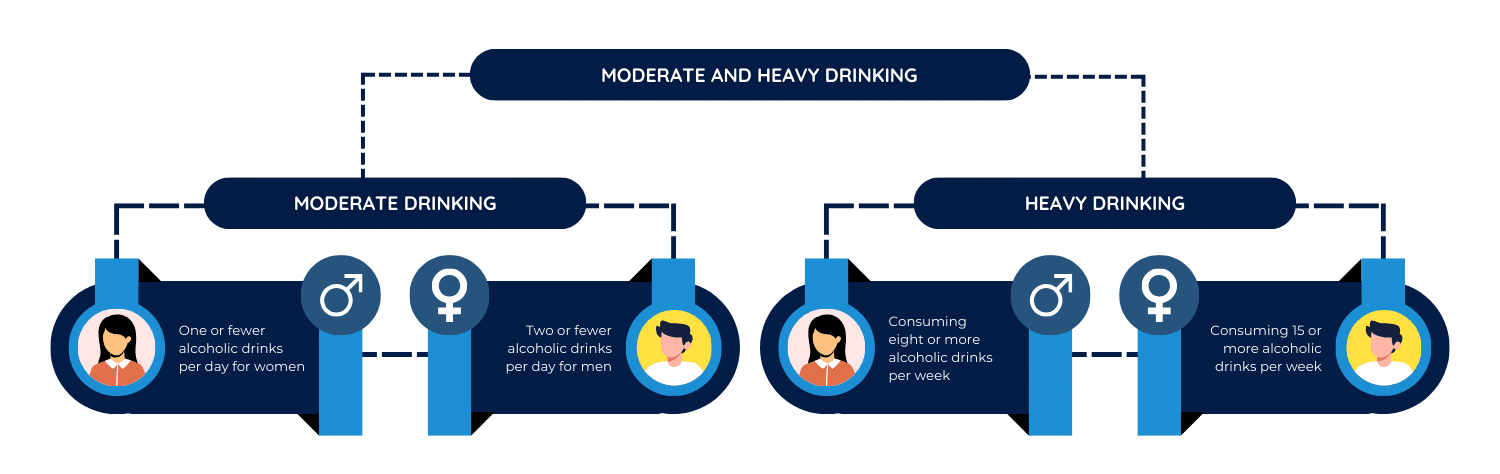
| Heavy drinking | 8+ drinks per week for women, or 15+ drinks per week for men |
| Moderate drinking | Up to 1 drink per day for women, or up to 2 per day for men |
“Moderate” doesn’t mean “risk-free.” Many health authorities now emphasize that drinking less is better for health. (Verify the current wording of federal guidance before publishing.)
Research shows that drinking heavily increases the risk of developing alcohol addiction.
Recognizing the Stages of Alcohol Addiction
Alcohol addiction typically develops in stages. Recognizing the early stages of alcohol addiction can help you find treatment programs to overcome AUD.
 The stages of alcohol addiction are:
- Pre-alcoholic stage: People may consume alcohol in response to peer pressure or may self-medicate physical and emotional pain by drinking.
- Early-stage alcohol addiction: People develop a tolerance to alcohol. They may need to drink more to get the desired effects of alcohol or be able to drink a lot without appearing or feeling intoxicated.
- Middle-stage alcohol addiction: People’s tolerance increases, leading to more heavy drinking. People may experience physical symptoms related to their drinking, including fatigue, bloating, tremors, rapid weight gain or loss, and sweating. Friends and family members may become concerned about a person’s drinking.
- End-stage alcohol addiction: People cannot control their alcohol consumption. Their body depends on alcohol to function. If they stop drinking, they experience severe withdrawal symptoms, including seizures, elevated blood pressure, anxiety, and insomnia. People with end-stage alcohol addiction require medical interventions and alcohol addiction treatment to survive.
A note on the stages: The four stages above are a common way of describing how drinking can progress, but they are an informal model, not a medical diagnosis, and not everyone moves through them in order. Clinicians instead describe AUD as mild, moderate, or severe, based on how many of the 11 criteria apply.
Withdrawal can be dangerous. If you have been drinking heavily and regularly, your body may be physically dependent. Stopping suddenly can cause tremors, sweating, rapid heartbeat, anxiety, hallucinations, and seizures. Talk to a doctor or treatment provider before you stop, and seek emergency care for a seizure, severe confusion, or hallucinations. For free, confidential treatment referrals, call the SAMHSA National Helpline at 1-800-662-4357 (24/7).
Alcohol addiction treatment typically consists of medical detox programs, mental health treatment, education, counseling, and other forms of evidence-based support. It is essential to address the complex roots of addiction so that people can work toward lifelong recovery.
It is critical to seek treatment as soon as you recognize the signs of alcohol abuse or addiction. People who regularly engage in binge drinking or heavy drinking may quickly develop an inability to control their alcohol use. Get treatment as soon as you recognize problematic drinking behaviors.
Early Warning Signs of a Drinking Problem
- Drinking more than you planned, or more often than you planned
- Needing more alcohol to feel the same effect
- Thinking about drinking a lot, or planning your day around it
- Drinking to cope with stress, sadness, anxiety, or trouble sleeping
- Hiding or minimizing how much you drink
- Feeling irritable, shaky, or anxious when you haven’t had a drink
- Friends or family expressing concern
- Trying to cut down and not being able to
If several of these sound familiar, it’s worth talking to a professional. You can also take our Am I an Alcoholic? quiz. It is not a diagnosis, but it can help you decide on a next step.
How Alcohol Use Disorder Is Treated
Effective treatment is available at every level of severity, and it works better the earlier it starts. It often includes:
- Medical detox when needed. Supervised withdrawal management keeps people safe from seizures and other complications.
- Therapy. Cognitive behavioral therapy (CBT), motivational approaches, and family therapy help people change patterns and manage triggers.
- Medication for AUD. Naltrexone, acamprosate, and disulfiram can reduce cravings or discourage drinking, and are prescribed by a clinician.
- Treatment for co-occurring conditions such as anxiety, depression, or trauma, which often drive drinking.
- Ongoing support. Peer groups and aftercare help maintain recovery.
At Moving Mountains Recovery in Randolph, NJ, we help clients access detox placement when medical withdrawal support is needed, and we provide Partial Care (PHP), Intensive Outpatient (IOP), and Outpatient (OP) care, plus dual-diagnosis treatment. Learn more about alcohol addiction treatment. Call (973) 453-0317 or verify your insurance. If you’re in crisis, call or text 988.
Frequently Asked Questions About Becoming an Alcoholic
How long does it take to become an alcoholic?
There’s no set timeline. Clinicians use the term alcohol use disorder (AUD), which can develop over weeks, months, or years depending on how much and how often you drink, when you started, genetics, mental health, and environment. Heavy daily drinking can cause physical dependence within weeks to months, but patterns vary widely.
How much do you have to drink to become an alcoholic?
There’s no exact amount. Heavy drinking, defined as 8 or more drinks per week for women or 15 or more for men, and regular binge drinking raise the risk, but AUD is diagnosed by symptoms and behavior, not a number. Drinking to cope, strong cravings, and being unable to cut down are stronger signs.
Can you become dependent on alcohol after just a few weeks?
It’s possible for physical dependence to start within weeks to months of sustained heavy daily drinking, especially with repeated binge cycles. Full alcohol use disorder more often develops over a longer period, but it varies. If you notice tolerance or withdrawal symptoms like shakiness or sweating, talk to a doctor.
What are the early signs of alcoholism?
Early signs include drinking more or longer than planned, needing more to feel the same effect, strong cravings, drinking to cope with stress or sleep, hiding how much you drink, feeling irritable or shaky without a drink, and being unable to cut down. Friends or family expressing concern is another sign.
What is the difference between being an alcoholic and having alcohol use disorder?
“Alcoholic” is an everyday term, while alcohol use disorder (AUD) is the medical diagnosis. AUD is diagnosed using 11 DSM-5 criteria, with 2-3 meaning mild, 4-5 moderate, and 6 or more severe. Only a clinician can diagnose it, and treatment works at every severity level.
What are the stages of alcoholism?
A common informal model describes four stages: pre-alcoholic, early, middle, and end-stage. Not everyone moves through them in order, and it isn’t a medical diagnosis. Clinicians instead classify alcohol use disorder as mild, moderate, or severe, based on how many criteria a person meets.
Is it dangerous to quit drinking suddenly?
It can be. If you have been drinking heavily and regularly, stopping suddenly can cause tremors, sweating, rapid heartbeat, hallucinations, and seizures, which can be life-threatening. Talk to a doctor or treatment provider before you stop, and call 911 for a seizure, severe confusion, or hallucinations.
How is alcohol use disorder treated, and where can I get help?
Treatment can include medical detox, therapy such as CBT, medications like naltrexone or acamprosate, treatment for co-occurring conditions, and ongoing support. Call the SAMHSA Helpline at 1-800-662-4357 for free referrals. Moving Mountains Recovery offers Partial Care, Intensive Outpatient, and Outpatient programs in New Jersey. Call (973) 453-0317.
References:
- National Institute on Alcohol Abuse and Alcoholism (NIAAA): Alcohol Use Disorder (AUD) in the United States: Age Groups and Demographic Characteristics
- Centers for Disease Control and Prevention (CDC): Alcohol Use and Your Health
- NIAAA: Alcohol’s Effects on Health
- Science Direct: Impact of early, weekly drinking on latent classes of alcohol involvement progression and recovery: Evidence from the NESARC Waves 1 and 2